A shot produces an outcome, not an expectation value. The expectation emerges from repeated preparations and measurements under a defined operating condition. A useful experiment therefore specifies three things before acquisition: what quantity it estimates, how uncertainty will be bounded, and when the observations permit a decision. A large shot count cannot rescue an undefined quantity or a rule chosen after seeing the answer.
The interactive lab prepares a Bell pair and measures XX, YY, and ZZ on separate preparations. Each two-bit string contributes parity +1 for 00 or 11 and −1 for 01 or 10. Averaging gives three estimated correlations. The observed Bell score is
S = (1 + C_XX - C_YY + C_ZZ) / 4.The minus sign reflects the ideal Bell state's YY correlation of −1. This score includes the lab's measurement noise; it is not automatically the fidelity before readout.
Make the stopping rule part of the experiment
The lab allows seven cumulative looks: 100, 200, 500, 1,000, 2,000, 5,000, and 10,000 shots per basis. Its interval has half-width
w(n) = (3/4) sqrt[2 ln(42/0.05) / n].Accept when the lower endpoint is at least 0.90 and the unrounded half-width is at most 0.04. Reject when the upper endpoint is below 0.90. Otherwise continue to an affordable declared look, or finish inconclusive.
The factor 42 accounts for two tails, three bases, and seven looks. Hoeffding's inequality bounds each independent, bounded sample mean; allocating error probability across the 21 basis/look combinations and taking a union bound protects the entire declared family. The nested looks need not be independent. The guarantee assumes that shots within each basis estimate a stable mean under the declared sampling model. Hoeffding's original result.
This construction permits stopping at those seven looks. It does not license checking after every shot, adding another look after a disappointing result, or repeatedly restarting until one run accepts. Those are different experimental designs. A confidence sequence addresses a broader monitoring horizon, but that is not the implemented contract. Confidence-sequence research.
Follow a captured run
The following values come from the committed Qiskit Aer capture, using the recorded baseline parameters p=0.02 and q=0.01. They are simulator observations, not hardware measurements or manually selected counts.
| Shots per basis | Observed score | Half-width | Decision |
|---|---|---|---|
| 100 | 0.955000 | 0.275229 | continue |
| 500 | 0.961000 | 0.123086 | continue |
| 1,000 | 0.954500 | 0.087035 | continue |
| 2,000 | 0.955250 | 0.061543 | continue |
| 5,000 | 0.956100 | 0.038923 | accept |
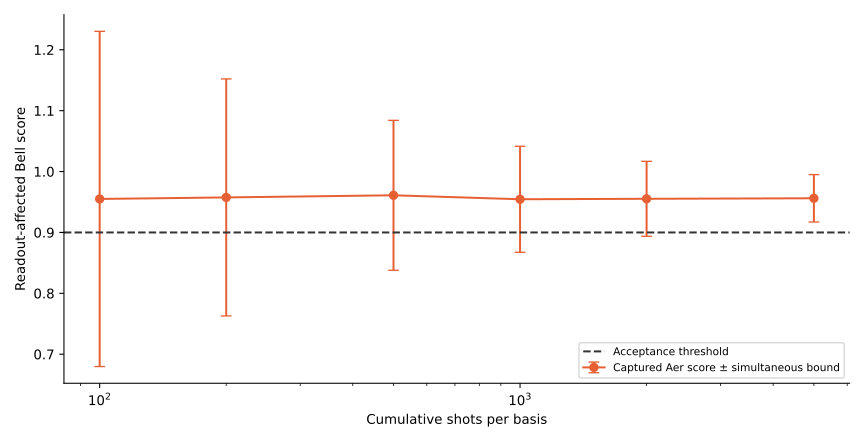
At 5,000, the interval is approximately [0.917177, 0.995023]. Both acceptance requirements hold. The total acquisition is 15,000 shots, not 5,000. Moving from the 2,000-shot look to the 5,000-shot look adds 3,000 shots in each basis; adding another 5,000 would overshoot the declared schedule.
The captured budget-limited scenario stops at 1,000 per basis with the same observed score, 0.954500. Its interval spans approximately [0.867465, 1.041535], so it is inconclusive. Budget exhaustion has not demonstrated poor quality. Conversely, the degraded capture rejects at 200 per basis: its upper endpoint, 0.807116, is already below the target.
An interval may extend beyond the physical range. Keep the raw half-width for decisions. Clipping a displayed endpoint to one must not make an imprecise experiment appear to satisfy the width requirement.
Check the method without replacing its justification
The coverage fixture contains separate Monte Carlo checks, not additional Aer evidence. At zero true correlation magnitude, 52 of 10,000 trials missed at least one simultaneous correlation interval; the pointwise exact binomial interval for that miss probability is approximately [0.003886, 0.006814]. No score interval missed in those trials. This checks an independent numerical calculation of the statistical construction; production arithmetic is checked separately. Neither finite check proves universal coverage. Zero observed misses also does not imply zero underlying probability.
Exercise and worked answer
A colleague proposes accepting the baseline capture at 2,000 shots because its score, 0.955250, exceeds 0.90. Another proposes accepting the interrupted capture after its 200-shot checkpoint because execution can resume later. Identify both mistakes and calculate the additional shots required to reach the first possible precision-qualified look.
Worked answer: At 2,000, the lower endpoint is 0.893707 and the half-width is 0.061543; both acceptance conditions fail. The interrupted run remains operationally incomplete and statistically inconclusive. The width formula cannot reach 0.04 before 4,735 shots per basis, making 5,000 the first permitted qualifying look. From 200, that requires 4,800 additional shots per basis, or 14,400 total. Resume must preserve the existing counts and context, rather than quietly restarting or pooling a changed device state. Detecting Drift and Interpreting Alerts examines that boundary.